Spray foam roofing
Commercial Spray Foam Roofing
Commercial spray foam roofing gives flat and low-slope buildings a seamless, insulated, reflective roof that seals around HVAC equipment and can be tapered to improve drainage. On suitable roofs it goes over the existing system with less tear-off and disruption, and periodic recoating renews it. An inspection shows whether your building is a good candidate.
Spray Foam Roofing for Building Owners and Property Managers
If you own or manage a commercial building in the Valley, your roof is probably flat or low-slope, covered with HVAC units and exposed to some of the harshest sun in the country. Spray polyurethane foam (SPF) with a reflective elastomeric coating is one of the systems best suited to those conditions. It is seamless, lightweight, insulating and renewable, and it can often be installed or restored with less disruption than a conventional tear-off.
Payne Roofing has served Arizona since 1984 and works on commercial polyurethane foam roofs alongside metal, tile, built-up, single-ply and shingle systems, roof and wall coatings, waterproofing and new commercial builds. Because we work with many systems, we can tell you honestly whether foam is the right fit for your building or whether something else makes more sense.
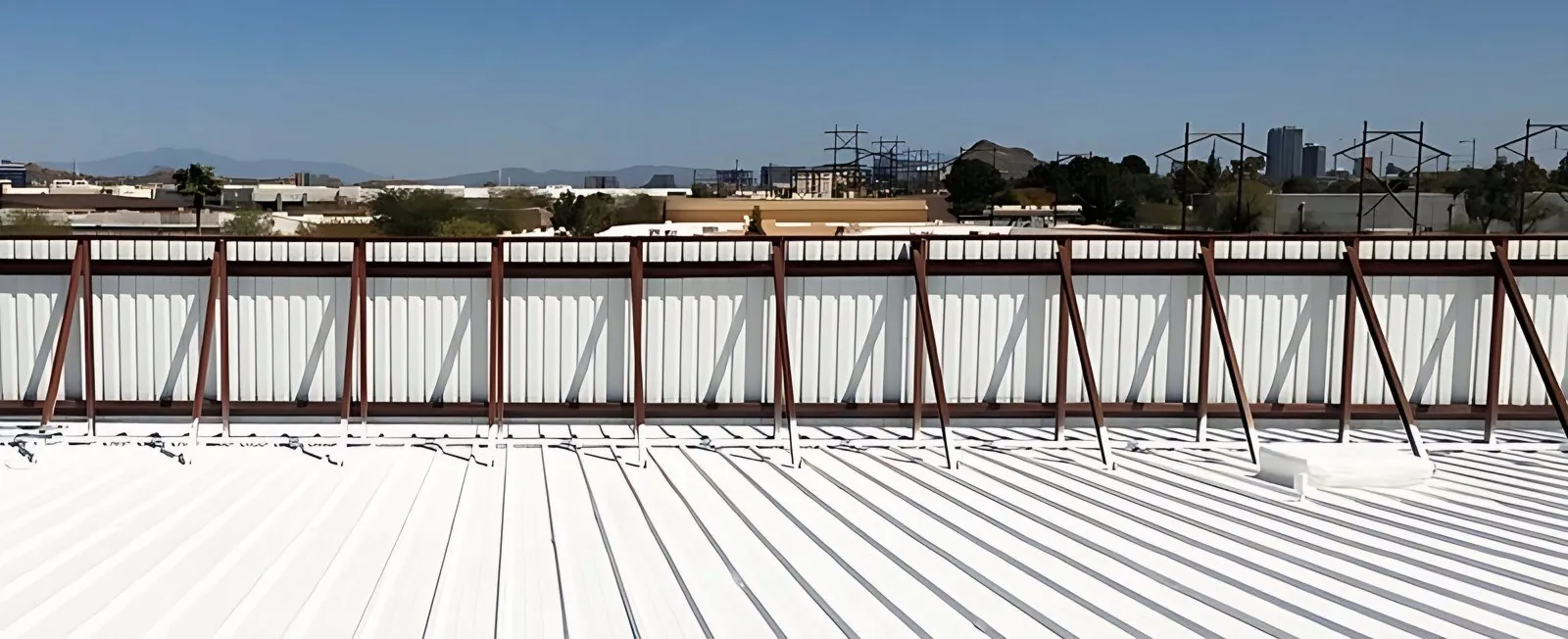
Energy Performance on Large Roofs
A commercial roof is a big surface collecting heat all day. Closed-cell roofing foam, roughly R-6 to R-7 per inch depending on the product, adds a continuous layer of insulation over the entire deck, and it also reduces air leaking through the roof assembly. Topped with a white reflective coating, the roof reflects much of the sun's energy instead of absorbing it.
Together, those effects can lower peak cooling loads, reduce heat flowing into the building and make top-floor spaces more comfortable for tenants and employees. Actual savings depend on the building's existing insulation, how it is used, air leakage, HVAC equipment and how clean the coating stays. Savings should be estimated for your specific building. We do not promise a fixed percentage, and you should be cautious of anyone who does.
Fewer Leaks Around Rooftop HVAC and Penetrations
On most commercial roofs, leaks start at the details: HVAC curbs, exhaust fans, plumbing vents, conduit, gas lines, equipment supports and parapet transitions. Conventional membranes require cutting, lapping and sealing around each one, and every seam is a future leak point.
Spray foam is applied as a liquid that expands into and around these shapes, forming a continuous surface with far fewer seams. Foam can also be built up around equipment to direct water away. The coating then goes on as a liquid too, following every contour, with reinforcing fabric and compatible sealants added where details need extra strength.
This does not mean details take care of themselves. Flashing, curb heights and coating thickness at penetrations still need careful work, and HVAC service traffic should be managed with walkway pads so technicians do not wear through the coating.
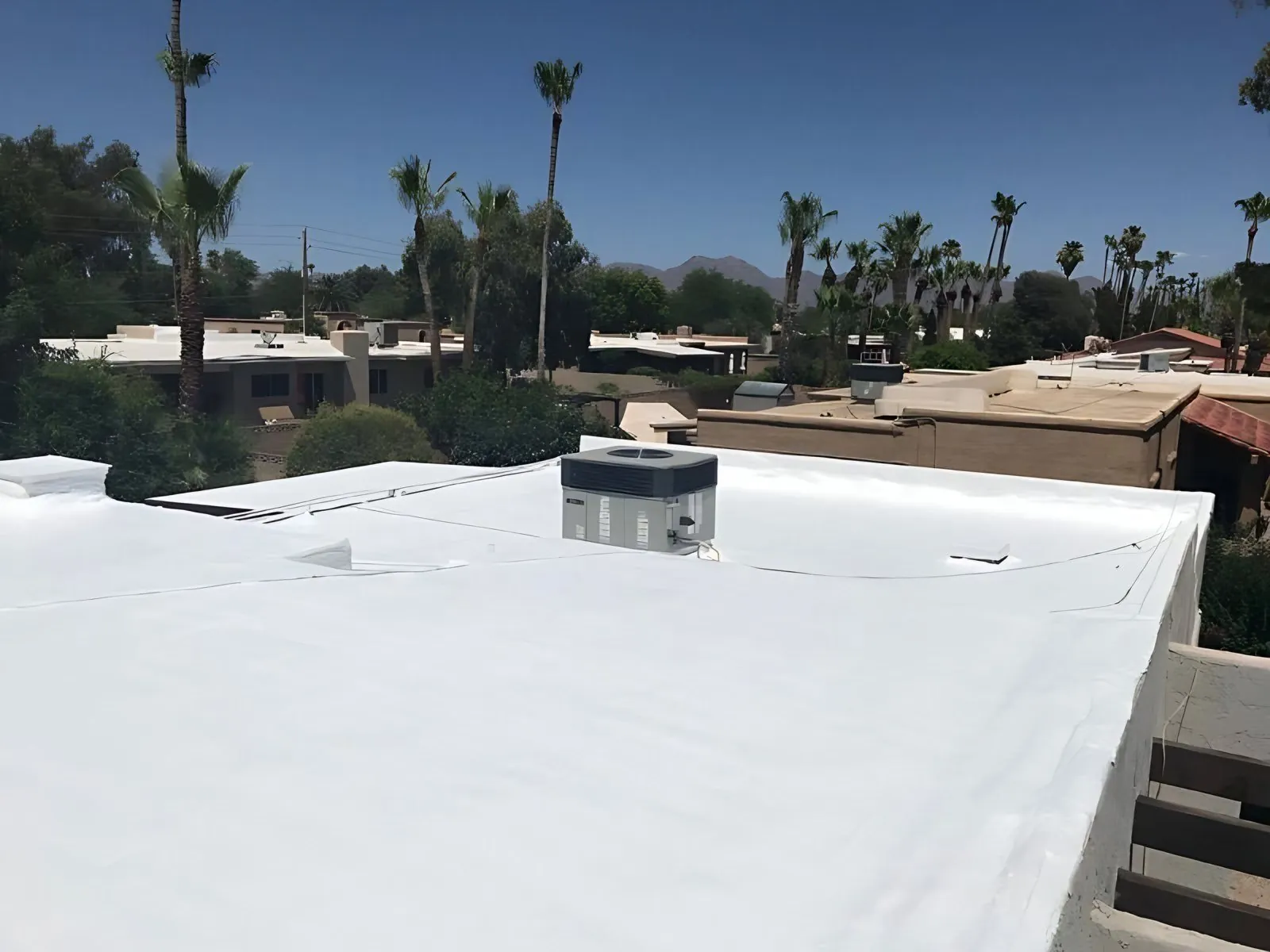
Drainage and Ponding
Ponding water is a constant issue on flat commercial roofs. Water that sits after a monsoon storm wears coatings faster, collects dirt and debris, adds load to the structure and finds any weak point. Clogged drains and scuppers after a haboob make it worse.
Spray foam offers a solution few systems can match. Because it can be applied at varying thickness, foam can be tapered to build slope toward drains and scuppers and to fill some low spots. This must be designed from a survey of the roof, and it works on suitable roofs, not every roof. A coating alone does not fix a major drainage problem. Where some ponding remains, a silicone coating generally tolerates standing water better than many alternatives. Learn more about coating choices on our silicone roof coatings page.
Less Disruption for Tenants and Operations
For many owners, the biggest headache of re-roofing is not the roof. It is the noise, debris, dumpsters and disruption to tenants and customers. Foam and coating projects can reduce that in several ways:
- Less demolition. On suitable roofs, foam or a restoration coating can go over the existing roof instead of tearing it off.
- Less waste. Avoiding tear-off means fewer dumpsters and less material sent to the landfill.
- Shorter projects in many cases, especially for recoats and restorations.
- Light weight, which often avoids structural work on existing buildings.
We plan access, staging, timing and safety with your team before work begins, and keep you informed throughout. Spraying foam and coatings does require attention to wind, overspray and air intakes, so we coordinate HVAC and building access carefully on each project.
Restoring Existing Commercial Roofs
Many existing commercial roofs, including some built-up, single-ply, metal and older foam roofs, can be restored instead of replaced if they are sound and dry. There are two main paths:
- Silicone restoration coating. Clean, repair, prime where needed and coat. This renews the waterproofing surface and adds reflectivity, but does not add meaningful insulation or change drainage.
- New spray foam over the existing roof. Spray closed-cell foam over the suitable existing roof, then coat it. This adds insulation, creates a seamless new surface and can correct drainage.
Neither is right when insulation is wet, moisture is trapped, the deck is deteriorated or the existing materials are incompatible. In those cases, the affected areas or the whole roof must come off first. Our foam roof recoating and restoration page explains how we make that call.
The Owner's View: Concerns and How the System Helps
| Owner concern | How SPF and coating help |
|---|---|
| High cooling bills | Insulating foam and a reflective coating reduce heat gain |
| Recurring leaks | Seamless foam and a continuous coating eliminate many seams |
| Crowded rooftop equipment | Sprayed and liquid-applied materials fit around complex shapes |
| Aging roof surface | Recoat without removing the foam |
| Ponding water | Foam can be tapered toward drains and scuppers |
| Cost of a full re-roof | Suitable roofs can be restored instead of torn off |
| Ongoing upkeep | Localized repairs and periodic recoats |
| Sun and weather exposure | The coating shields the foam from UV and weathering |
Warranty Questions to Ask
Commercial roof warranties vary widely, and the details matter more than the number of years. Payne Roofing's own roof repairs include a 2 to 5 year warranty, and complete re-roofs offer 10, 15 or 20-year warranty options. Foam and coating manufacturers may offer separate material or system warranties whose terms depend on the manufacturer, the system, foam and coating thickness, the installer and maintenance. Never assume their length or coverage. Before you sign, ask:
- Who issues the warranty: the manufacturer, the contractor or both?
- Are labor and materials both covered?
- Are installation defects covered?
- Is ponding water excluded?
- What inspections and maintenance are required to keep it in force?
- Must recoats be performed by an approved contractor?
- Does it transfer to a new owner if the building sells?
See our roof warranties guide for more background.
Maintenance Programs for Commercial Foam Roofs
A foam roof's long life depends on maintenance, and commercial roofs benefit most from a written program instead of reacting to leaks. A good program includes:
- Scheduled inspections at least once or twice a year, ideally spring and fall, plus after hail, major monsoon storms and haboobs.
- Drain and scupper cleaning so water does not pond.
- Penetration and flashing checks around HVAC units and other equipment.
- Prompt local repairs of punctures, bird pecks, hail damage and blisters.
- Walkway pads on routes technicians use.
- A recoat plan, typically roughly every 5 to 10 years depending on the coating, which can be staged by section on larger roofs.
- Written records of inspections, repairs, coating type and dates, which also help with warranty requirements.
Our commercial roof maintenance guide covers more of what to include.
Why Commercial Owners Work With Payne Roofing
- Serving Arizona since 1984, with over 40 years of experience
- Family owned and operated by Steven and Linda Payne
- Licensed, bonded and insured under Arizona ROC #138549 and ROC #194202, which you can verify at roc.az.gov
- Member of the Arizona Roofing Contractors Association (ARCA)
- Experience with foam, metal, tile, built-up, single-ply and shingle commercial roofs, plus coatings, waterproofing and new commercial builds
- 100% satisfaction guarantee, free estimates and flexible financing options
We serve commercial properties in Phoenix, Mesa, Tempe, Chandler, Gilbert, Queen Creek, San Tan Valley, Apache Junction and Cave Creek. Every project starts with an inspection and a written estimate. Call 480-988-9250, Monday through Friday from 7:00 am to 5:00 pm or Saturday from 8:00 am to 2:00 pm, or contact us. See our full commercial roofing services and the main spray foam roofing page.
Common questions
Is spray foam a good roof for a commercial building?
Spray foam is a strong choice for many commercial buildings with flat or low-slope roofs, especially in Arizona. It is seamless, lightweight, insulating, works well around rooftop equipment and can be shaped to improve drainage. Whether it fits your building depends on the existing roof, deck condition, moisture, drainage and how the roof is used.
Can spray foam be installed without closing my business?
In many cases, yes. Foam and coating projects often involve less demolition and noise than a tear-off, and we plan access, staging and timing with you to limit disruption. Spraying does require care with wind, overspray and HVAC air intakes, so we coordinate closely with your team before and during the work.
Will spray foam reduce my building's cooling costs?
It can, because foam insulation, reduced air leakage and a reflective coating together cut heat gain through the roof. How much depends on the building's existing insulation, use, air leakage, HVAC equipment and coating cleanliness. Savings should be estimated for your building, and no one should promise a fixed percentage.
Can foam go over our existing commercial roof?
Often, yes, if the existing roof is sound, dry and compatible with foam. Many built-up, single-ply and metal roofs are candidates. Foam should not go over wet insulation, trapped moisture, a deteriorated deck or incompatible materials. An inspection, including moisture checks, determines whether the roof can stay or must come off.
Should we restore our roof with silicone or install new foam?
Choose silicone restoration when the existing roof is sound, dry and drains reasonably well, and you mainly need a renewed waterproof, reflective surface. Choose new foam when you also want added insulation, a seamless new surface or improved drainage. Condition, moisture, insulation goals and budget decide which approach fits.
How do you handle leaks around HVAC units?
We start by finding where water is getting in, which is often failed flashing, worn coating or damaged curbs. On a foam roof, damaged material is cut out, re-foamed and detailed with compatible coating, fabric or sealant. Walkway pads around units help prevent technicians from wearing through the coating during service visits.
What maintenance does a commercial foam roof need?
A commercial foam roof needs inspections once or twice a year and after major storms, clear drains and scuppers, checks around penetrations, prompt repair of small damage and recoating roughly every 5 to 10 years depending on the coating. A written maintenance program with records keeps the roof on schedule and supports warranty requirements.
What warranty does Payne Roofing offer on commercial foam roofs?
Payne Roofing's roof repairs include a 2 to 5 year warranty, and complete re-roofs offer 10, 15 or 20-year warranty options. Manufacturer warranties are separate and depend on the product, system, thickness and maintenance. We review which warranties apply to your project, in writing, before work begins.
Can a large commercial roof be recoated in phases?
Yes, large roofs can often be recoated in phases to fit a budget. We prioritize exposed foam, ponding areas and traffic paths first, and schedule the remaining sections over time. No area should be left with exposed foam while it waits, so the plan always protects the whole roof.
Talk to a roofer who knows Arizona roofs.
Call for a free estimate. Open Monday through Friday 7–5 and Saturday 8–2.