Our specialty
Spray Foam Roofing & Silicone Coatings
Spray polyurethane foam (SPF) is a seamless, lightweight roof that insulates, seals around rooftop equipment and can be shaped to improve drainage. It must be protected by an elastomeric coating, often white silicone in Arizona, that blocks UV and can be renewed. Maintained and recoated on time, a foam roof can serve for decades.
What Is Spray Foam Roofing?
Spray polyurethane foam, usually shortened to SPF, is a roofing system that starts as two liquid components. They are mixed at the spray gun and applied directly onto the roof, where the mix expands within seconds and cures into a firm, closed-cell foam that bonds to the surface below. The result is one continuous layer of insulation and waterproofing with no sheets, laps or seams across the open roof.
Foam is never the finished surface. Once the foam is in place, it is covered with an elastomeric coating, most often a white silicone or acrylic, that protects the foam from sunlight and weather. Together, the foam and the coating make up the roof system. Think of the foam as the insulated foundation and the coating as the skin that takes the weather.
Payne Roofing has been serving Arizona since 1984, and foam roofing and elastomeric and emulsion coatings have long been part of our work on homes and commercial buildings across the Phoenix area and East Valley. Because foam is such a good fit for flat and low-slope roofs in our climate, it gets more attention on this site than any other topic. This page explains every major advantage of SPF, why the coating over it matters so much, and the honest limits you should know before choosing it.
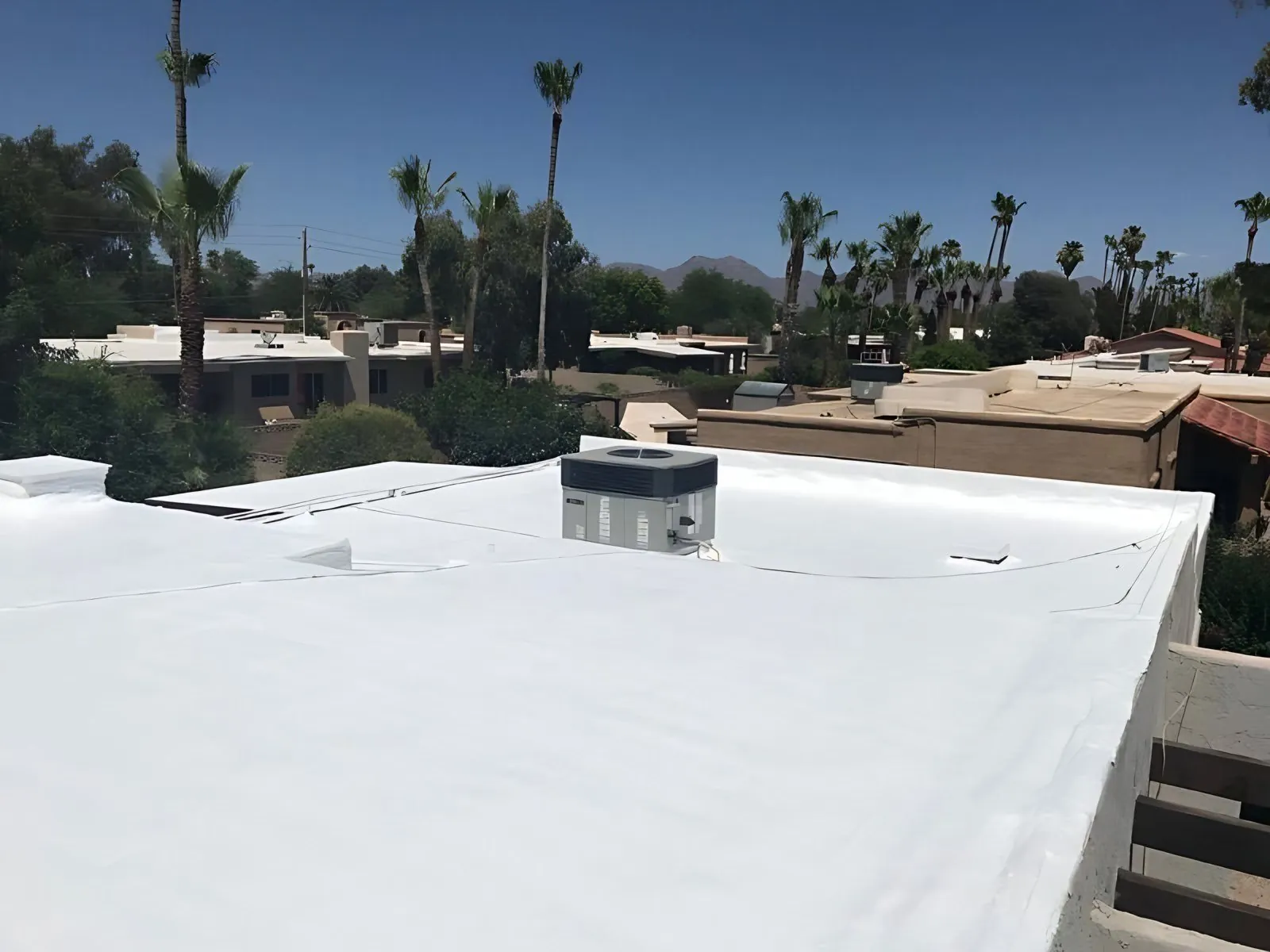
How the Foam and the Coating Work Together
A foam roof is a two-part system, and each part has a job the other cannot do.
- The foam insulates, blocks air movement, adds rigidity, sheds water and can be sprayed thicker in some areas to build slope toward drains.
- The coating shields the foam from UV, adds a second waterproofing layer, reflects sunlight, resists wear and can be renewed over and over.
The single most important rule is simple: spray foam must never be left exposed to the sun. Polyurethane foam breaks down under UV light. Unprotected foam changes color, turns brittle and powdery on the surface, and slowly loses thickness. A properly applied coating at the right thickness prevents that, and as long as the coating is maintained, the foam beneath it can keep doing its job for a very long time.
That relationship is what makes foam roofing different from many other flat roof systems. When a foam roof's surface wears, the usual answer is not a tear-off. It is a cleaning, repairs where needed and a fresh coat. You renew the surface and keep the insulation.
SPF Advantages: Energy, Comfort and Air Sealing
1. Strong insulation value
Closed-cell roofing foam is one of the more effective insulating materials used on roofs, roughly R-6 to R-7 per inch depending on the product. Because it sits on top of the deck as one continuous layer, it slows heat moving into the building in summer and out of it in winter. The real-world effect depends on how much insulation the building already has, how it is used, air leakage, local climate and the HVAC equipment.
2. Resistance to air infiltration
Closed-cell foam is applied as a continuous layer that adheres to the deck, so it also helps reduce air leaking through the roof assembly. Less uncontrolled air movement can mean fewer drafts, more even indoor temperatures and less work for the air conditioner. Keep in mind the roof is one part of the building envelope. Walls, windows, doors and ducts all play a role in how tight a building really is.
3. Better overall building energy performance
When the foam's insulation and air sealing are paired with a reflective white coating, the whole roof works to reduce heat gain. That can lower peak cooling loads, reduce heat flow through the roof and make rooms under it more comfortable. We are careful here: energy savings must be estimated building by building. No honest contractor can promise a fixed percentage, and we will not.
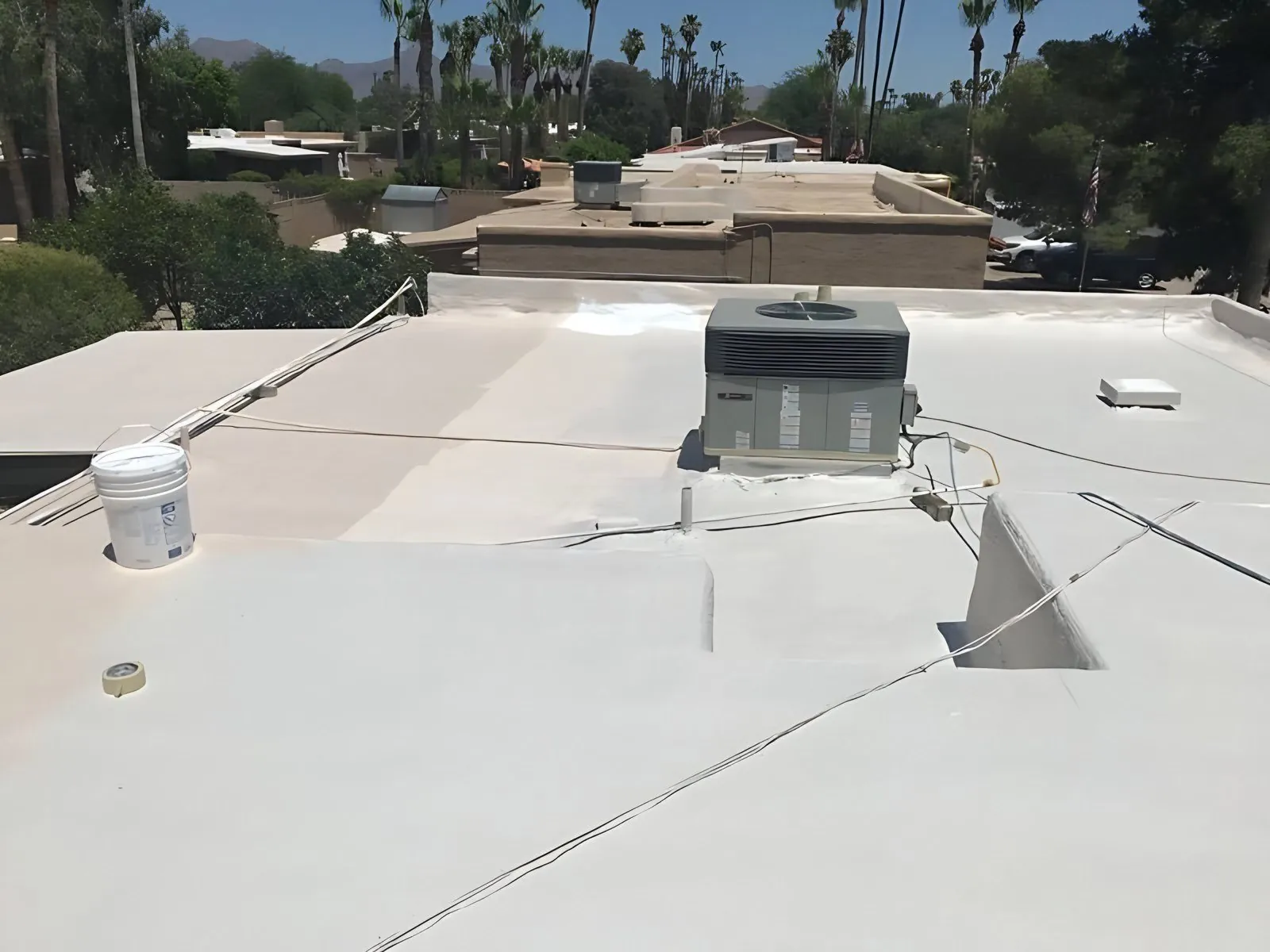
SPF Advantages: Waterproofing, Drainage and Tough Details
4. Seamless waterproofing
Because the foam is sprayed in place, there are no sheet seams across the field of the roof, and seams are where many flat roofs eventually leak. Fewer joints means fewer paths for water, and the foam wraps continuously around penetrations and irregular shapes with little reliance on mechanical fasteners. The caveat: foam on its own is not the complete waterproofing system. It must be protected with a compatible coating.
5. Strong adhesion to many surfaces
SPF bonds well to many properly prepared substrates, including concrete, wood, metal and some existing roof surfaces. That bond helps hold the whole assembly together and lets the foam follow uneven surfaces. Adhesion is only as good as the preparation, though. The substrate has to be clean, dry, sound and compatible with foam, and some surfaces need a primer first.
6. Excellent around rooftop equipment
Air conditioning curbs, evaporative coolers, vents, plumbing pipes, conduit and supports are where conventional roofs often fail, because every cut and lap is a potential leak. Foam can be sprayed into and around these complex shapes, cutting down the number of seams in the details and even building slope away from equipment. Those areas still need careful flashing, sealing and coating detail work. Spraying foam is not a substitute for doing them right.
7. Correcting drainage and low spots
One of foam's unique strengths is that it can be applied at different thicknesses. A thicker application in some areas and thinner in others can create slope toward drains and scuppers, fix some low spots and reduce ponding on suitable roofs. This has to be planned from a survey of the roof, not improvised. A coating by itself will not cure a major drainage problem.
8. Adaptable to many roof shapes
Foam works well on flat and low-slope roofs, roofs crowded with penetrations, oddly shaped roofs with parapets and transitions, restorations over suitable existing roofs and roofs that need tapered insulation for drainage. That flexibility is a big reason foam is so common in Arizona, where flat roofs with parapet walls are part of both commercial buildings and many homes. Not every roof is a candidate, and an inspection decides that.
SPF Advantages: Light Weight, Strength and Weather Resistance
9. Lightweight
A foam roof adds very little dead load to the structure compared with many heavier systems. That makes it suitable for some existing buildings that cannot carry more weight, and in some cases it avoids the need for structural reinforcement. It can sometimes be installed over an existing roof without a full tear-off, but only after a qualified roofing professional evaluates what is already there.
10. Resistance to everyday roofing stresses
Roofing-grade closed-cell foam has good compressive strength for a roof, absorbs far less water than open-cell foam and stays dimensionally stable through temperature changes. It handles normal roof conditions well. It is not indestructible. Hard impacts, heavy or careless foot traffic, certain chemicals and UV exposure from a worn coating can all damage it.
11. Good wind-uplift resistance
Because a foam roof is fully adhered to the substrate and has few seams or loose edges, there is less for strong wind to grab and peel back. That matters during monsoon storms and haboobs. The assembly still has to be designed and installed to meet the building code requirements for the specific location and building.
12. Hail and debris resistance
The closed-cell structure helps limit how far water can travel if the surface is damaged, and the foam offers some cushioning against impacts. Hail can still dent foam and break the coating, and wind-blown debris can puncture it. After any hailstorm, the roof should be inspected and damaged spots repaired promptly so water does not get into the foam.
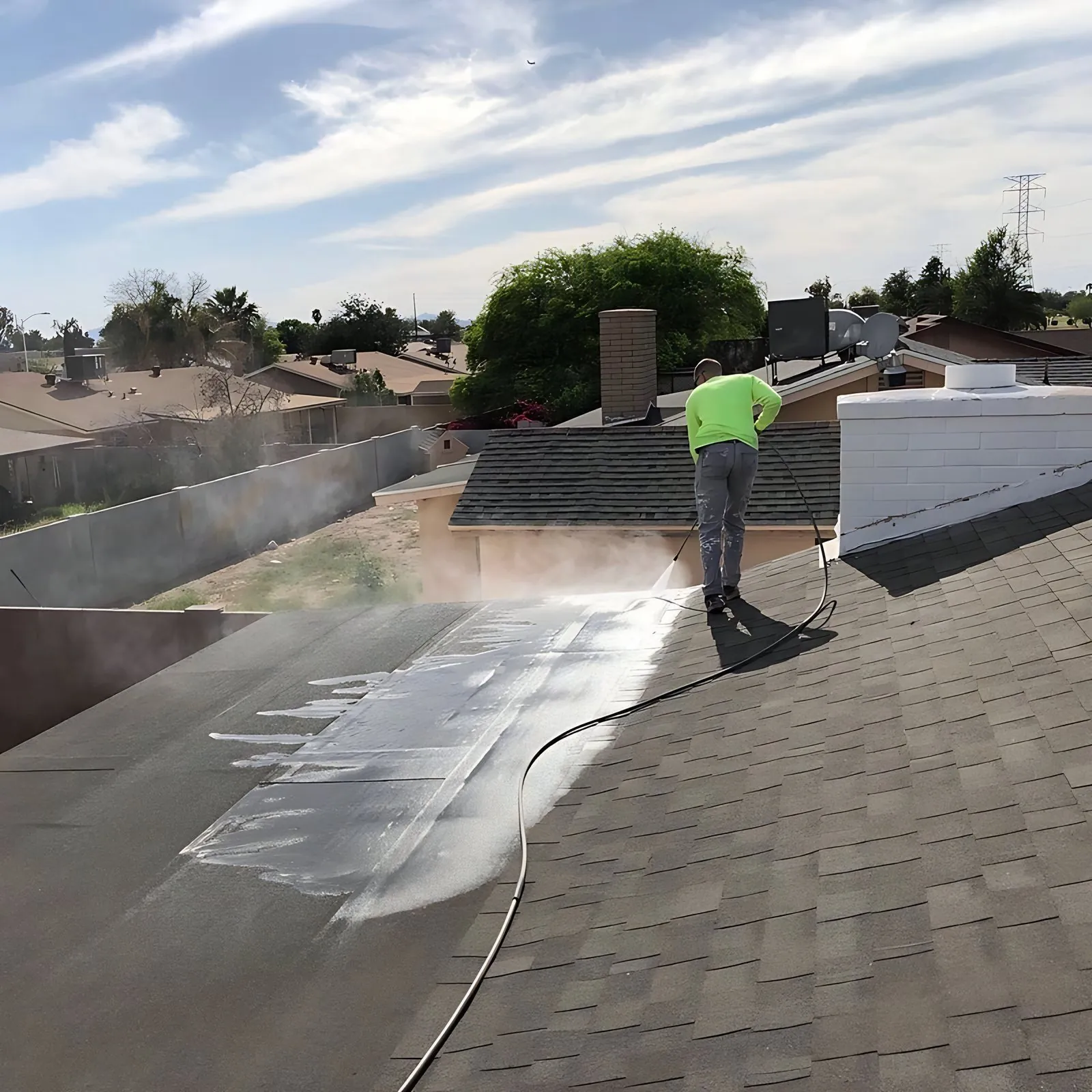
SPF Advantages: Long Life, Easy Repairs and Long-Term Value
13. Long service life with maintenance
A foam roof that is installed correctly, kept coated, inspected and maintained can serve for decades. How long a particular roof lasts depends on foam quality and thickness, adhesion, the coating system, sun and ponding exposure, foot traffic, the quality of repairs over the years and following the manufacturer's specifications. The coating will need renewal along the way while the foam itself remains serviceable.
14. Simple, localized repairs
Damaged foam does not usually mean a large repair. A damaged area can often be cut out, filled with new foam and recoated, which is far less disruptive than replacing a roof section. The repair has to extend to sound, dry material and use compatible products, or the problem simply moves to the edge of the patch.
15. Less demolition on suitable restorations
When an existing roof is sound, dry and compatible, foam can sometimes go over it instead of tearing it off. That means less demolition, less waste headed to the landfill, less disruption and often a shorter project. It is not an option over wet insulation, trapped moisture, a rotted or deteriorated deck, or materials foam will not bond to.
16. Potentially lower long-term cost
Over the life of the building, foam can make financial sense: possible energy savings, less frequent full replacement, localized repairs, less demolition and the ability to renew the coating instead of replacing the foam. Whether that holds for your building depends on the initial installation, how well it is maintained, how often it is recoated and the condition of the roof today. We explain those factors in a free estimate rather than quoting numbers that may not fit your roof.
Coating Advantages: Protecting the Foam
The elastomeric coating is what turns foam into a lasting roof. These are the advantages it brings.
1. UV protection for the foam
This is the coating's most important job. Unprotected foam discolors, becomes brittle and powdery on top and gradually erodes. In Arizona sun, that process is fast. A continuous coating at the specified thickness blocks the UV and keeps the foam intact.
2. An extra waterproofing layer
The coating forms a continuous film over the foam and seals minor surface imperfections, giving the roof a second line of defense against water. It has limits. A coating cannot fix wet foam, major cracks, failed flashing or poor drainage. Those must be corrected before it goes on.
3. Resistance to water intrusion
A well-applied coating keeps rain and standing water from reaching the foam. How well it does that depends on applying it at the right thickness, preparing the surface properly, detailing flashing correctly and keeping water draining off the roof.
4. Protection against surface wear
The coating takes the abrasion, light impacts and weathering that would otherwise wear down the foam. Standard roof coatings are not designed for heavy foot traffic, so walkway pads or reinforced paths should be added to routes that technicians use regularly, such as around HVAC units.
5. Some chemical resistance
Coatings can help protect foam from exhaust, airborne contaminants and residue from rooftop equipment. Resistance varies by product, so the coating should be chosen for the actual exposure on the roof, such as a restaurant exhaust hood or industrial equipment.
6. Less weather deterioration overall
Sun, moisture and the daily swing from blazing afternoons to cooler nights all work on a roof. The coating absorbs that punishment so the foam does not have to, slowing the deterioration of the whole system.
7. Preserves the insulation
Foam insulates best when it is dry and intact. By keeping water and UV out, the coating protects the insulating value you paid for, so the roof keeps performing year after year.
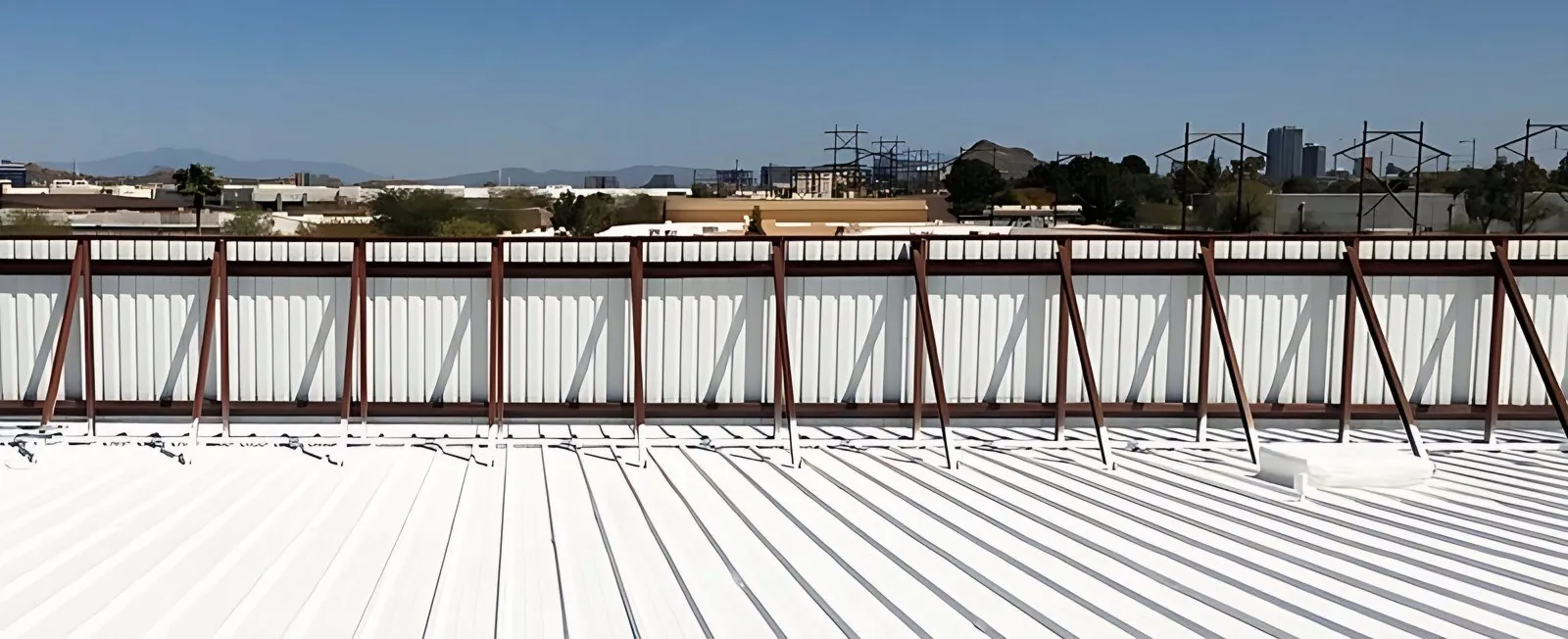
Coating Advantages: Performance, Details and Appearance
8. Reflects sunlight
White and other highly reflective coatings bounce much of the sun's energy away, lowering the roof surface temperature and the heat that moves into the building. The benefit depends on the coating's reflectance and emittance, how clean the roof stays and how much insulation is underneath.
9. Flexibility
Elastomeric coatings stretch and recover as the roof expands in the afternoon heat and contracts at night, and they can bridge minor surface cracks. They cannot bridge structural movement, such as a moving joint in the building, unless that area is properly detailed.
10. Handles complex details
Because it goes on as a liquid, the coating follows pipes, vents, curbs and flashing transitions. Reinforcing fabric and compatible sealants are added where details need extra strength.
11. A uniform, fresh appearance
A newly coated roof looks clean and consistent, which matters for properties visible from neighboring buildings or upper floors. Appearance is not proof of condition, though. A roof can look fine and still have wet foam or failing details underneath, which is why inspections matter.
12. Fire performance, when tested
Some foam and coating assemblies carry fire ratings, but only as tested and approved combinations. A coating does not give any roof a fire rating on its own. Requirements depend on the building and local code, so the system documentation should be verified for each project.
Coating Advantages: A Roof You Can Renew
13. Extends the life of the whole system
Instead of replacing the foam, the coating can be renewed: inspect the roof, repair foam and flashing, prepare the surface and recoat at the specified thickness. This works as long as the foam stays sound and dry.
14. Makes maintenance practical
A coated foam roof has a clear, manageable maintenance routine: clean the surface, keep drains and scuppers clear, check penetrations, repair small damage locally and recoat when the coating wears thin.
15. Reduces re-roofing waste
When the foam is still sound, renewing the coating avoids tearing off and hauling away a roof. That means far less material sent to the landfill compared with a full replacement.
16. Can be renewed in stages
Large roofs can sometimes be recoated in phases to fit a budget, as long as no area is left unprotected while waiting its turn. Badly worn sections are addressed first.
17. Makes the roof renewable
This is the advantage that ties all the others together. Many roof systems have to be torn off when they wear out. A foam roof lets you renew the surface and keep the insulation, so a well-maintained roof can be recoated many times over its life.
Comparing Coatings Over Spray Foam
Three coating families are commonly used over SPF. Performance varies by product and formulation, so treat this as a general guide rather than a rule.
| Quality | Silicone | Acrylic | Polyurethane |
|---|---|---|---|
| UV resistance | Excellent | Generally good | Depends on formulation (aliphatic types are UV-stable) |
| Ponding water | Generally excellent | Often limited under prolonged ponding | Depends on formulation |
| Reflectivity | Excellent when new and white | Excellent when new and white | Varies with product and color |
| Dirt pickup | Can collect dirt, which reduces reflectivity | Varies by product | Varies by product |
| Toughness and abrasion | Varies; some are soft | Moderate | Some are very tough and abrasion resistant |
| Cleanup | Generally solvent | Water-based | Generally solvent |
| Recoating later | Needs compatible prep; often silicone over silicone | Generally straightforward with proper prep | Needs compatible prep and materials |
| Often a good fit for | Exposed roofs with ponding concerns | Roofs with good drainage where budget matters | Roofs needing extra toughness or foot traffic |
For a deeper look at how these coatings compare, including ponding, dirt pickup and recoat compatibility, see our page on silicone roof coatings over spray foam.
Why White Silicone Over Closed-Cell Foam Suits Many Arizona Roofs
For many flat and low-slope roofs in hot, sunny climates like ours, a white silicone coating over closed-cell SPF is an excellent combination. Here is why:
- Ponding resistance. Even well-drained flat roofs can hold some water after a monsoon downpour, and silicone generally holds up well where water sits for a while.
- UV and weather resistance. Silicone resists breakdown from intense sunlight, which our roofs get almost every day of the year.
- Flexibility in temperature extremes. It stays flexible through scorching afternoons and cooler nights.
- Reflectivity. A clean white silicone surface reflects a large share of the sun's heat.
- A recognized SPF coating. Silicone is a well-established protective coating for foam roofs.
That said, silicone is not automatically the right answer for every roof. Drainage, foot traffic, the existing coating and budget all factor in, and we will tell you if a different coating fits your roof better.
Silicone Limitations to Understand
Every coating has trade-offs, and silicone's are worth knowing before you choose it:
- Dirt pickup. Silicone surfaces can hold onto dust, and Arizona has plenty of it. Dirt lowers reflectivity over time, so periodic cleaning helps.
- Demanding recoat adhesion. Not much sticks to silicone. Future recoats require proper cleaning, compatible materials and often silicone over silicone.
- Softness. Some silicone coatings are relatively soft, so walkways are important where technicians regularly cross the roof.
- It will not fix structural or drainage problems. A coating protects a roof. It does not correct a sagging deck or a roof that drains poorly.
- Installation quality is critical. Surface prep, achieving the specified thickness, dry conditions and careful detailing make the difference between a coating that performs and one that fails early.
What a Foam and Coating System Means for a Building Owner
Whether you own a home with a flat roof or manage a commercial property, these are the common concerns a foam and coating system can address:
| Your concern | How the system helps |
|---|---|
| High cooling bills | Foam insulation plus a reflective coating reduce heat gain through the roof |
| Roof leaks | Seamless foam and a continuous coating remove many seams where leaks start |
| Difficult rooftop details | Sprayed and liquid-applied materials fit complex shapes around equipment and penetrations |
| An aging roof surface | The roof can be recoated without removing the foam |
| Poor drainage | Foam can be tapered to build slope toward drains and scuppers |
| High re-roofing costs | Suitable existing roofs may be restored instead of torn off |
| Ongoing maintenance | Localized repairs and periodic recoats keep the system working |
| Harsh weather exposure | The coating protects the foam from UV and weathering |
Service Life and Warranty
Industry guidance from the Spray Polyurethane Foam Alliance, the trade group for the SPF industry, holds that a properly maintained foam roof can serve for decades with regular inspections and recoating. In practice, the foam often outlasts the original coating, which is why recoating, typically every 5 to 10 years depending on the coating, is part of owning a foam roof.
Payne Roofing's warranty
Our roof repairs include a 2 to 5 year warranty, and our complete re-roofs offer 10, 15 or 20-year warranty options. Every project is backed by our 100% satisfaction guarantee. We will explain in writing which warranty applies to your project before work begins.
Manufacturer warranties are separate
Foam and coating manufacturers may offer their own material or system warranties. Terms depend on the manufacturer, the specific system, foam and coating thickness, the installer and ongoing maintenance, so never assume a length or coverage. Read the actual warranty document. Our roof warranties guide explains the general differences.
Questions to ask about any roof warranty
- Who issues it: the manufacturer, the contractor or both?
- Does it cover labor as well as materials?
- Does it cover installation defects?
- Are there exclusions for ponding water?
- What inspections or maintenance are required to keep it valid?
- Must recoats be done by an approved contractor?
- Can it be transferred if the property is sold?
The System We Recommend
For most foam roofs, a durable, long-lived system comes down to five parts:
- A properly prepared substrate. Clean, dry, sound and compatible, with primer where needed.
- Closed-cell SPF at the specified thickness, applied for insulation and, where needed, to build drainage slope.
- A compatible white silicone elastomeric coating applied at the specified thickness.
- Properly detailed penetrations, drains, flashing and walkways, because details are where roofs succeed or fail.
- A written inspection and maintenance program, with repairs and recoats when the roof needs them.
Each part depends on the others. Excellent foam with a thin coating fails early. A perfect coating over wet foam fails too. The system works when all five are done right.
New Spray Foam Roofs vs. Restoring an Existing Roof
There are two different approaches, and it is important not to confuse them.
Installing a new SPF roof
A new foam system means spraying closed-cell foam onto a prepared deck or a suitable existing roof, then coating it. This adds insulation, can correct drainage and creates a seamless new roof. It is the right choice when you want the full benefits of foam, or when the existing roof is beyond restoration.
Restoring an existing roof with silicone
Many existing commercial roofs, including some foam, built-up, single-ply and metal roofs, can be restored with a silicone coating system if the roof is still sound and dry. Restoration involves cleaning, repairs, primer where needed and coating. It renews the waterproofing surface but does not add meaningful insulation or fix drainage the way new foam can.
Which approach fits depends on moisture in the existing roof, deck condition, drainage, insulation needs and budget. Learn more on our foam roof recoating and restoration page.
Foam Roofing in the Arizona Climate
Arizona puts a foam roof through conditions that make good installation and maintenance essential:
- Extreme heat and UV. Our sun is the main reason coatings wear and foam must never be left exposed. Reflective white coatings help counter summer heat gain.
- Monsoon season. From June 15 to September 30, storms can bring sudden heavy rain, strong winds and debris. That tests drainage, flashing and every weak spot in the coating. Coating work also needs dry conditions to cure, so we schedule around storms.
- Haboobs. Dust storms coat roofs in dirt, clog drains and scuppers and reduce reflectivity. Cleaning and drain checks after dust storms are worthwhile.
- Occasional hail. Hail can dent foam and crack the coating, so inspect after any hailstorm.
- Ponding. Flat roofs that hold water wear their coating faster. Foam can be tapered to improve drainage, and silicone tolerates ponding better than many coatings.
Our monsoon roof preparation guide covers how to get any roof ready before the storms arrive.
Foam Roofs for Homes, Not Just Commercial Buildings
Spray foam is not only for warehouses and shopping centers. Many Valley homes have flat or low-slope roofs where foam and coatings make a lot of sense:
- Territorial and pueblo-style homes with flat roofs and parapet walls, common throughout the Phoenix area.
- Flat roof sections on otherwise pitched homes, such as additions, Arizona rooms and porches.
- Patio covers and carports with low-slope roofs.
- Roofs with evaporative coolers or AC units mounted on top, where seamless foam around the equipment helps prevent leaks.
For homeowners, the appeal is the same: a seamless roof, added insulation over living space, a cooler reflective surface and a roof that can be renewed by recoating. If your HOA has rules about roof appearance, we can talk through what is visible from the street. Please do not walk on your roof to check it. Foam is durable, but footsteps in the wrong place and falls are real risks. Binoculars from the ground, a look for ceiling stains inside or a professional inspection are safer.
How Payne Roofing Handles a Foam Project
- Inspection. We look at the existing roof surface, coating condition, foam thickness and adhesion where relevant, signs of moisture, deck condition, drainage, flashing and rooftop equipment. We note what we find.
- Clear recommendation. We explain whether repair, recoating, restoration, new foam or a different system makes the most sense, and why.
- Written estimate. You get a written estimate that describes the scope of work. Estimates are free, and flexible financing options are available.
- Scheduling around the weather. Foam and coatings need dry conditions and suitable temperatures, so we plan around monsoon storms and coordinate access with you, your tenants or your HOA.
- Preparation and installation. We clean and prepare the surface, make repairs, apply foam and coating to the specified thickness and detail penetrations, drains and flashing carefully.
- Walkthrough and ongoing care. We review the finished work with you and recommend an inspection schedule, ideally in spring and fall and after major storms.
Payne Roofing is family owned and operated by Steven and Linda Payne, licensed, bonded and insured under Arizona ROC #138549 and ROC #194202, and a member of the Arizona Roofing Contractors Association. We serve Phoenix, Mesa, Tempe, Chandler, Gilbert, Queen Creek, San Tan Valley, Apache Junction and Cave Creek. Call 480-988-9250, Monday through Friday from 7:00 am to 5:00 pm or Saturday from 8:00 am to 2:00 pm, or request your free estimate online.
Learn More About Foam Roofing
- Silicone Roof Coatings Over Spray Foam: how silicone compares with acrylic and polyurethane, and when it is not the right choice.
- Foam Roof Recoating and Restoration: signs it is time to recoat, the repair-then-recoat process and when tear-off is needed.
- Commercial Spray Foam Roofing: what foam means for building owners and property managers.
- Spray Foam Roof Care and Recoating guide and the Spray Foam Roofing FAQ.
Common questions
What is a spray foam roof?
A spray foam roof is a seamless roof made by spraying liquid polyurethane that expands into a firm, closed-cell foam bonded to the surface below. The foam insulates and sheds water, and it is always finished with an elastomeric coating that protects it from sunlight. The foam and coating together form the complete roof system.
Why does spray foam need a coating?
Spray foam needs a coating because polyurethane foam breaks down in sunlight. Exposed foam discolors, turns brittle and powdery and slowly erodes, which happens quickly under Arizona UV. The coating blocks that UV, adds a second waterproofing layer and reflects heat, and it can be renewed over time without replacing the foam.
How much insulation does spray foam add to a roof?
Closed-cell roofing foam typically provides roughly R-6 to R-7 per inch, depending on the product, and it is applied as one continuous layer. The total depends on how thick the foam is. How much difference it makes to comfort and cooling also depends on the building's existing insulation, air leakage, use and HVAC equipment.
Will a foam roof lower my energy bills?
It can, because foam insulation, reduced air leakage and a reflective white coating all reduce heat moving through the roof. How much depends on the building, its existing insulation, how it is used and its HVAC system. Savings should be estimated for each building, so we do not promise a fixed percentage.
How long does a spray foam roof last?
A properly installed and maintained spray foam roof can last for decades. The foam often outlasts its original coating, so the roof is typically recoated roughly every 5 to 10 years depending on the coating. Regular inspections, prompt repairs and timely recoating are what make a long service life possible.
Can spray foam go over my existing roof?
Sometimes, yes, if the existing roof is sound, dry and compatible with foam. A qualified roofer must inspect it first. Foam should not go over wet insulation, trapped moisture, a rotted deck or incompatible materials. When those problems exist, the affected material or the whole roof has to be removed first.
Can spray foam fix ponding on a flat roof?
On suitable roofs, yes. Foam can be sprayed thicker in some areas and thinner in others to build slope toward drains and scuppers and to fill some low spots. This needs to be planned from a survey of the roof. A coating alone will not correct a significant drainage problem.
Is silicone the best coating for a foam roof?
White silicone is an excellent choice for many Arizona foam roofs because it resists UV, generally handles ponding water well and is highly reflective when clean. It is not right for every roof. Silicone can collect dirt, some products are soft and future recoats require compatible materials, so drainage, traffic and existing coatings matter.
How often should I plan to recoat a foam roof?
Most foam roofs need recoating roughly every 5 to 10 years, depending on the coating type, its original thickness, sun exposure, ponding and foot traffic. An inspection that checks for thin or chalky coating and exposed foam is the best way to know when your roof is due. See our recoating page for the signs.
Are spray foam roofs good for homes?
Yes, spray foam is a good fit for many homes with flat or low-slope roofs, including territorial and pueblo-style homes, flat additions, patio covers and roofs with coolers or AC units on top. Homeowners get a seamless roof, added insulation over the living space and a reflective surface that can be renewed by recoating.
Does hail damage a spray foam roof?
Hail can dent foam and crack or puncture the coating, though the closed-cell foam offers some cushioning and helps limit water travel. Damage should be repaired promptly so water does not get into the foam. Have the roof inspected after any hailstorm or severe monsoon storm.
What warranty comes with a foam roof from Payne Roofing?
Payne Roofing's repairs include a 2 to 5 year warranty, and complete re-roofs offer 10, 15 or 20-year warranty options, all backed by our 100% satisfaction guarantee. Manufacturer material or system warranties are separate and depend on the product, system and maintenance, so we review the actual documents with you.
What should I ask about a roof warranty?
Ask who issues the warranty, whether it covers labor and materials, and whether installation defects are included. Also ask about ponding exclusions, required inspections or maintenance, whether recoats must be done by an approved contractor and whether it transfers if you sell. Getting answers in writing avoids surprises later.
Can I walk on a foam roof?
A coated foam roof can handle light, careful foot traffic, but we recommend homeowners stay off the roof for safety. Heavy traffic, dropped tools and sharp objects can damage the coating, and some silicone coatings are soft. Walkway pads around HVAC equipment protect areas technicians use regularly.
What does a foam roof cost?
Cost depends on the roof's size, whether existing roofing must be removed, the condition of the deck, foam thickness, drainage corrections, the coating chosen and how many penetrations need detailing. Because every roof differs, the most reliable answer is a free written estimate after an inspection. Flexible financing options are available.
When is the best time to install or recoat a foam roof?
The best time is during dry weather with suitable temperatures, because foam and coatings need dry surfaces to bond and cure. In Arizona, that usually means planning around monsoon storms, which run from June 15 to September 30. We watch forecasts closely and schedule work for dry stretches.
Talk to a roofer who knows Arizona roofs.
Call for a free estimate. Open Monday through Friday 7–5 and Saturday 8–2.